I am sure most of us has the experience of falling down a bike or having an ulcer inside our mouths. Usually, the bleeding would stop after a few minutes and the healing process begins, where the skin tries to repair itself. The healing process begins with clearing out the bacteria from the site of wounding with white blood cells, the “knight” in our body that protects us from harmful things. Then our damaged cells repair itself and most of the time, this process happens and leaves no scar. However, the strength and elasticity of our newly healed skin is going to be weaker compared to our original skin. Healed skin is also bad at cooling down our skin as it lacks sweat glands that help us sweat when we are hot. In certain cases, the wound does not heal within three months and result in a chronic wound. There are lots of downside with prolonged wounds, that includes itching, more pain and a bigger risk of infection with more trouble to take care of the wound.
There are stem cells in our skin that can help with the healing process in chronic wounds. Stem cells are like children, where they have not yet chosen their job, they could be a liver cell, a skin cell, or a muscle cell. Just like how kids can choose to be a teacher, an engineer, or an artist when they grow up. All the cells in our body started as stem cells, but once they have decided what they want to be, they become differentiated and stick to their job. Stem cells are very cool because they aid in speedy recovery of the skin, as everyone knows that broken skin cause a lot of pain. In a disease that cause skin to be fragile that leads to blistering on all parts of the body, especially on hands and feet. Some groups of scientists have shown skin stem cells to aid in recovery.
In babies that are not yet born, scientists have found out that they do not scar when surgeries are performed on them, unlike adults. Scientists from top universities are working hard to try and find out the reason behind this and hope to reduce scarring in people in the future.
MSCs therapy for skincare
The normal regeneration of the epidermis is only guided by a few self-renewing stem cell clones that can self-renew and generate progenitor cells to supplement terminally differentiated keratinocytes, and it is mesenchymal stem cells that have such repair potential. A large number of clinical Previous and clinical trials have shown that mesenchymal stem fines (MSCs) treatment can accelerate wound healing, bringing hope for the treatment of various chronic wounds that are difficult to heal.
- Why mesenchymal stem cells?
Mesenchymal stem cells are members of the stem cell family and have the ability to replicate and have strong differentiation potential. Adult mesenchymal stem cells (MSCs) are pluripotent stem cells derived from mesoderm and are widely used in the field of regenerative medicine. MSCs can differentiate into fat, cartilage, bone, nerve cells, endothelial cells, etc. The latest reports can also be transdifferentiated and induced into hematopoietic stem cells; MSCs can secret dozens of hundreds of factors, including growth factors, cytokines, chemokines, Enzymes, etc., play a vital role in the growth and repair of tissues and organs.
- Why so special?
Mesenchymal stem cells can change their nature and play different functions according to the size of the inflammation, or the location of the inflammation: it can both anti-inflammatory and pro-inflammatory. The most important characteristic of mesenchymal stem cells is that they have a strong immunomodulatory effect. The human body’s internal environment is complex and changeable. Under different inflammation conditions, the immune regulatory effects of mesenchymal stem cells are different. Scientists have found that the immune regulation of mesenchymal stem cells has such a “chameleon” characteristic, it seems to be a mediator of the inflammatory environment: when the inflammatory response is strong, it will suppress the immune response; when the inflammatory response is weak, it Instead, it may promote an immune response. Mesenchymal stem cells have the advantage that other stem cells do not have, that is, they have the unique ability to migrate to injured tissues and regulate the immune response according to the specific environment, which makes them have great potential in clinical application.
- Good application prospect in skin lesions?
Adult mesenchymal stem cells have the potential to be transformed into endothelial cells. Combined with biological amniotic membrane, they have a good application prospect in skin lesions caused by burns and trauma. Cytokines and growth factors secreted by mesenchymal stem cells can regulate inflammatory responses, induce angiogenesis, enhance epithelial cell growth, and accelerate the formation of granular tissue and extracellular matrix. Several studies have confirmed that the application of mesenchymal stem cell therapy in the whole body or in the wound can promote the repair of damaged skin and improve the quality of healing. Mesenchymal stem cell therapy can promote angiogenesis during wound healing and shorten the patient’s recovery time. Not only that, mesenchymal stem cells have a good effect on chronic refractory wounds or unhealed wounds.
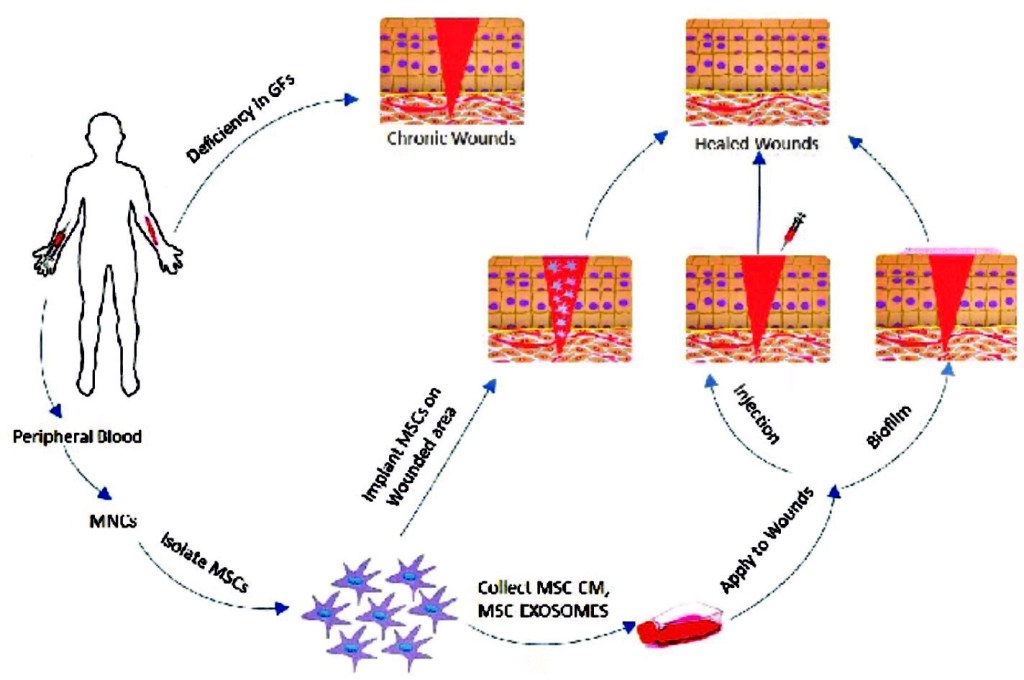
Potential applications of MSCs in wound healing. MSC therapy contributes to skin wound healing via two mechanisms: (1) Differentiation into skin-like cells, thereby compensating for the loss cells due to damaged tissue. (2) Promote proliferation and migration of skin cells into the injury site by secreting soluble factors and macrovesicles. MSC secretions represented by MSC-CM and MSC-EXOSOME can be either injected onto the wounded skin area or applied on skin wound using biofilm dressings.
 Skin Regeneration